

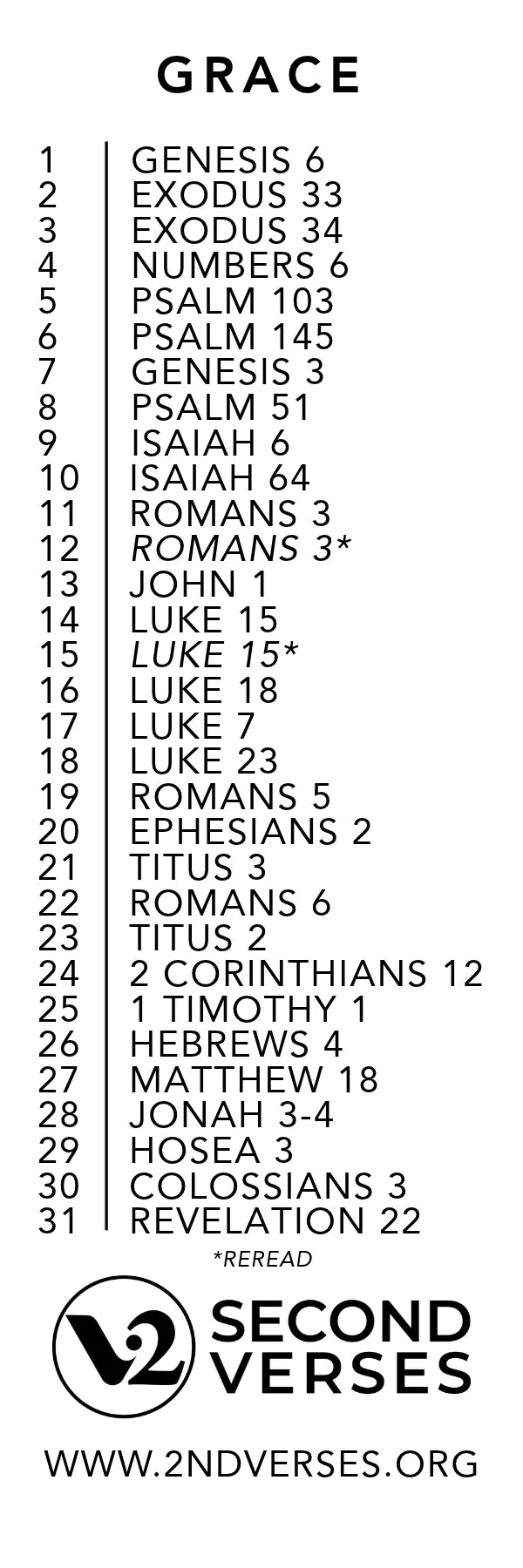
31 Days of Grace: A SOAP & SONG Bible Reading Plan
What Is SOAP & SONG?
SOAP & SONG is a discipleship method that pairs the SOAP Bible study format with reflective songwriting. SOAP stands for:
Scripture: Read the passage and write out the verse that stands out.
Observation: Note what the text says. Who is speaking, what is happening, and what does it reveal about God?
Application: Ask what this truth means for your life today.
Prayer: Respond to God in your own words.
SONG turns the Application step into lyric writing. Instead of only journaling what a passage means, you write lines of a psalm, hymn, or spiritual song in response to it, following the pattern of Colossians 3:16 and Ephesians 5:19. Writing lyrics slows you down, forces specific language, and helps Scripture stay with you after the reading is over.
31 Days of Grace is a one-month Bible reading plan from SOAP & SONG that traces the grace of God from Genesis to Revelation. Each day you read one full chapter of Scripture, study a single focus passage using the SOAP method (Scripture, Observation, Application, Prayer), and respond by writing your own lyrics with guided songwriting questions. No musical experience is required.
The plan follows five movements: grace revealed in the Old Testament, the depth of our unworthiness, grace poured out in Jesus Christ, grace at work in the believer, and grace extended to others. It works for personal devotions, church small groups, Bible study classes, and discipleship groups.
31 Days of Grace
How to Use This Reading Plan
Read the full chapter. Each day lists a complete chapter so you see the focus passage in its context.
Return to the focus passage. Reread the shorter passage slowly. This is where the day's theme of grace comes into view.
Work through SOAP. Write out the anchor verse (Scripture), record what you notice (Observation), consider what it means for you (Application), and pray.
Answer the song prompt questions in order. Jot words, phrases, and images as you go. The questions move from reflection toward a finished line.
Keep one line. You are collecting honest lines, not writing a finished song each day. One good line is a successful day.

Rhyme is optional. The Psalms rarely rhyme in English. Honest, specific words matter more than rhyme.
Use concrete images. "Kitchen table at 2 a.m." carries more weight than "a dark time."
Borrow Scripture's words. Lifting a phrase from the day's passage into your lyric is encouraged.
Read your lines out loud. Speaking a line reveals its natural rhythm. Adjust until it feels singable.
Try a familiar hymn meter. Many classic hymns use common meter (8.6.8.6 syllables per line, as in "Amazing Grace"). Counting syllables to a known tune gives your words a ready-made melody.
Keep everything. By the end of the month, your 31 lines can become the raw material for a full song.
Songwriting Tips for First-Time Writers
Movement One: Grace Revealed
(Days 1-6)
Day 1 | Read Genesis 6
Focus passage: Genesis 6:5-8
Anchor: "But Noah found favor in the eyes of the LORD." (6:8)
Focus: The first appearance of grace in Scripture lands in the middle of a verdict on human wickedness. Grace shows up where judgment is deserved.
Song prompt: Write about a moment you were spared something you had earned.
Where were you, and what was about to happen? List three physical details from that moment (a room, a sound, a face).
What did you expect to hear or feel? What came instead?
Verse 8 begins with "But." Write one line that starts with "But" and turns your story toward grace.
If this became a chorus, what four or five words would you want to sing over and over?
Day 2 | Read Exodus 33
Focus passage: Exodus 33:12-23
Anchor: "I will be gracious to whom I will be gracious." (33:19)
Focus: Grace is God's freedom, not our leverage. Moses asks to see glory; God answers with goodness and mercy.
Song prompt: What would you say to God if you could only ask one thing?
Write your one request as plainly as you can, in a single sentence.
Moses asks to see glory and God hides him in the rock. Where do you feel hidden or covered right now? Describe it as a place.
What do you think God's answer to your request might sound like? Write it in His voice, based on what this chapter shows about Him.
Put your question and His answer side by side. Could they become a call-and-response between verse and chorus?
Day 3 | Read Exodus 34
Focus passage: Exodus 34:1-9
Anchor: "The LORD, the LORD, a God merciful and gracious, slow to anger, and abounding in steadfast love and faithfulness." (34:6)
Focus: God's own self-description, given right after the golden calf. Note what He says about Himself first.
Song prompt: Turn 34:6-7 into your own words. Make it a chorus.
Circle each word God uses to describe Himself. Which one surprises you most, given what Israel just did?
Rewrite each description in everyday language, the way you would explain it to a friend.
God repeats His own name ("The LORD, the LORD"). What phrase in your chorus could repeat like that?
Read your chorus aloud. Does it sound like something you could sing after your own worst day?
Day 4 | Read Numbers 6
Focus passage: Numbers 6:22-27
Anchor: "The LORD make his face to shine upon you and be gracious to you." (6:25)
Focus: The blessing God puts on His people is grace spoken over them by name.
Song prompt: Write a blessing you would speak over someone who does not deserve it.
Who comes to mind? You do not have to use their name on the page, but picture their face.
What would you ask God to give them that you would find hard to ask for?
The priestly blessing has three short lines that build. Write your blessing in three lines, each a little bigger than the last.
How does it change you to say these words out loud? Write one line about what happens in you as you bless them.
Day 5 | Read Psalm 103
Focus passage: Psalm 103:1-14
Anchor: "He does not deal with us according to our sins, nor repay us according to our iniquities." (103:10)
Focus: List every benefit David names. Sit with the distance of east from west.
Song prompt: Write your own "bless the LORD, O my soul" list from the last twelve months.
List at least five specific things God has done for you this past year. Be concrete: a date, a phone call, a meal, a diagnosis, a door.
Which of these did you not deserve? Mark them.
David uses a picture (east from west) to describe distance. What picture from your own life could describe how far God has removed your sin?
Choose your three strongest items and write each as one line that starts with a verb, like David does ("who forgives," "who heals").
Day 6 | Read Psalm 145
Focus passage: Psalm 145:1-9
Anchor: "The LORD is gracious and merciful, slow to anger and abounding in steadfast love." (145:8)
Focus: The same self-description from Sinai, now sung back to God as worship.
Song prompt: Write one verse that a generation after you could sing.
Who is the next generation for you? Children, grandchildren, students, the men and women you serve?
What do you want them to know about God's grace that you had to learn the hard way?
Write it in simple words they would understand without explanation.
Verse 4 says one generation shall commend His works to another. Write a closing line that hands the song to them.
Movement Two: The Depth of Our Unworthiness
(Days 7-12)
Day 7 | Read Genesis 3
Focus passage: Genesis 3:8-24
Anchor: "And the LORD God made for Adam and for his wife garments of skins and clothed them." (3:21)
Focus: Consequence and covering in the same passage. Something died to clothe them.
Song prompt: What are you still trying to cover with fig leaves?
What are your fig leaves? Make a list: habits, excuses, reputations, busyness, silence.
God asks, "Where are you?" How would you honestly answer that question today?
Write two lines side by side: one about the covering you made, one about the covering God made.
What does it cost to be clothed by God instead of yourself? Try to put that in a single image.
Day 8 | Read Psalm 51
Focus passage: Psalm 51:1-12
Anchor: "Against you, you only, have I sinned and done what is evil in your sight." (51:4)
Focus: David asks for mercy before he asks for anything else. He names the sin without minimizing it.
Song prompt: Write a confession you would be willing to sing out loud.
What is one thing you tend to soften when you talk about it? Write it without softening.
David asks to be washed, purged, cleansed, created new. Which of those words matches what you need most?
Write a line asking God for that, in your own words.
Verse 12 asks for joy to be restored. End with one line about what joy would look like on the other side of this confession.
Day 9 | Read Isaiah 6
Focus passage: Isaiah 6:1-7
Anchor: "Woe is me! For I am lost." (6:5)
Focus: Seeing God clearly is what makes Isaiah see himself clearly. The coal comes from the altar, not from Isaiah.
Song prompt: Write about the difference between feeling guilty and being cleansed.
Describe what guilt feels like in your body. Where do you carry it?
Isaiah's lips are the problem and his lips are what get touched. What part of your life needs that direct touch?
Write one verse in the key of guilt and one in the key of cleansing. Use the same opening words for both so the contrast is clear.
The chapter ends with "Here I am! Send me." What would you be free to say or do once cleansed?
Day 10 | Read Isaiah 64
Focus passage: Isaiah 64:5-9
Anchor: "All our righteous deeds are like a polluted garment." (64:6)
Focus: Not our worst days, our best ones. Then: "you are our Father... we are all the work of your hand."
Song prompt: What good thing have you been offering God as payment?
List the good things you do that you secretly count on: service, giving, attendance, knowledge, a clean record.
Pick one. Write honestly about why it feels like it should count.
Verse 8 turns to the image of clay and potter. Write a line that sets down your "payment" and picks up that image.
Try a two-line couplet: the first line about your hands, the second about His.
Day 11 | Read Romans 3
Focus passage: Romans 3:9-20
Anchor: "None is righteous, no, not one." (3:10)
Focus: Paul closes every mouth before he opens any door. Read it as if it were written about you personally.
Song prompt: Write one line that admits what this passage says about you.
Reread verses 10-18 and replace "they" with "I." Which line is hardest to say?
Why is it hard? Write that reason in one sentence.
Verse 19 says every mouth will be stopped. What argument have you been making in your own defense?
Now write the one line of admission. Keep it short enough to sing in one breath.
Day 12 | Reread Romans 3
Focus passage: Romans 3:21-26
Anchor: "Justified by his grace as a gift, through the redemption that is in Christ Jesus." (3:24)
Focus: The hinge of the month. "But now" changes everything that came before it.
Song prompt: Write a "but now" verse. Before, and then what God did.
Look back at yesterday's line of admission. That is your "before."
Write two or three lines describing your life before, using concrete images rather than general words like "lost" or "broken."
Write the words "But now" on their own line. Let it sit.
Finish with two or three lines about what God did. Use at least one word from verse 24: justified, grace, gift, redemption.
Movement Three: Grace Poured Out in Christ
(Days 13-20)
Day 13 | Read John 1
Focus passage: John 1:14-18
Anchor: "From his fullness we have all received, grace upon grace." (1:16)
Focus: Grace has a face. Grace and truth arrive together, not in tension.
Song prompt: Write about grace upon grace. What does the second wave look like?
Think of a time God's grace met you once. Now think of a time it met you again, after you needed it a second time.
What image fits "grace upon grace" for you? Waves, rain, layers, refills, footsteps?
Write a verse that builds, each line adding one more wave.
John says the Word "dwelt among us." Where has grace shown up in a human face in your life?
Day 14 | Read Luke 15
Focus passage: Luke 15:11-24
Anchor: "While he was still a long way off, his father saw him and felt compassion, and ran." (15:20)
Focus: The son rehearses a speech. The father interrupts it.
Song prompt: Write the speech you rehearse before you come back to God, then write what He says instead.
Write your rehearsed speech word for word. What conditions are you offering?
Notice the son's speech never gets finished. Where would the Father cut you off?
Write the Father's response using only actions from the story: running, embracing, kissing, robe, ring, shoes, feast.
Could the speech be your verse and the Father's response be your chorus?
Day 15 | Reread Luke 15
Focus passage: Luke 15:25-32
Anchor: "All that is mine is yours." (15:31)
Focus: The older brother resents grace because he has been keeping score. Both sons need the father.
Song prompt: Where are you keeping score? Write it as an honest complaint, then answer it.
Who do you compare yourself to? What do you think you have earned that they have not?
Write the complaint in the older brother's tone. Let it be honest, even ugly.
The father goes out to him too. Write what the Father might say to your complaint, using verse 31 as a starting point.
End with a question the song leaves open, the way Jesus leaves the story unfinished. Does the older brother go in?
Day 16 | Read Luke 18
Focus passage: Luke 18:9-14
Anchor: "God, be merciful to me, a sinner!" (18:13)
Focus: Seven words go home justified. Compare what each man talks about in his prayer.
Song prompt: Write a one-line prayer you could say in a hard moment this week.
What hard moment do you see coming this week? A conversation, a court date, a hospital, a temptation, a count?
The Pharisee talks about himself. The tax collector talks about his need. What is your need in that moment?
Write your one-line prayer in ten words or fewer.
Say it aloud a few times. Does it have a natural rhythm? Adjust until it feels like something you could hum.
Day 17 | Read Luke 7
Focus passage: Luke 7:36-50
Anchor: "He who is forgiven little, loves little." (7:47)
Focus: Her worship is loud because her debt was large. Simon's restraint exposes what he thinks he owes.
Song prompt: Write about the size of your debt and the size of your love.
Are you more like the woman or more like Simon right now? Be honest.
The woman does not speak. Her worship is tears, hair, kisses, oil. What would your worship look like without words?
Write two lines comparing debt and love, using an image of size (a mountain, a pebble, an ocean, a cup).
Jesus says to her, "Go in peace." Write the last line of your song as what you hope to hear.
Day 18 | Read Luke 23
Focus passage: Luke 23:32-43
Anchor: "Today you will be with me in paradise." (23:43)
Focus: A man with no time left, no restitution made, and nothing to offer. Grace still reaches him.
Song prompt: Write from the criminal's point of view, the last hour.
What can he see, hear, and feel from the cross? List sensory details from the whole chapter.
What might he be thinking about his life? What does he know he cannot fix?
Write his request in verse 42 in your own words, the way he might have said it under his breath.
Write Jesus' answer as the final line. How does one word ("Today") change everything before it?
Day 19 | Read Romans 5
Focus passage: Romans 5:1-11
Anchor: "While we were still sinners, Christ died for us." (5:8)
Focus: Note the timing in verses 6, 8, and 10. Not after we cleaned up. While.
Song prompt: Write a verse that begins with the word "while."
Where were you and what were you doing when Christ's love reached you? Or where are you right now?
Write three lines that each start with "While" and describe your condition (while I was..., while I still...).
Answer them with one line about what Christ did.
Verse 5 says hope does not put us to shame. Is there a line of hope that could close the verse?
Day 20 | Read Ephesians 2
Focus passage: Ephesians 2:1-10
Anchor: "By grace you have been saved through faith. And this is not your own doing; it is the gift of God." (2:8)
Focus: Dead, following, by nature children of wrath. Then "But God, being rich in mercy."
Song prompt: Write the before and after using only what this passage says.
List every word Paul uses to describe life before: dead, following, disobedience, passions, wrath.
List every word he uses to describe life after: alive, raised, seated, saved, workmanship.
Pick the strongest word from each list and build one line around each.
Verse 10 calls us God's "workmanship," a word for something crafted. What would it mean to see yourself as His handmade work? Write one line about it.
Movement Four: Grace at Work in Us
(Days 21-26)
Day 21 | Read Titus 3
Focus passage: Titus 3:3-7
Anchor: "He saved us, not because of works done by us in righteousness, but according to his own mercy." (3:5)
Focus: Verse 3 is the honest inventory. Verses 4 through 7 are the rescue.
Song prompt: Write your own version of verse 3, then your own version of verse 5.
Rewrite verse 3 as "I was once..." and fill it with your own specifics.
Verse 4 begins "But when the goodness and loving kindness of God our Savior appeared." When did that appear for you? Write the moment.
Rewrite verse 5 in first person: "He saved me, not because..."
Which of your two verses feels more true on a hard day? Write one line that holds both together.
Day 22 | Read Romans 6
Focus passage: Romans 6:1-14
Anchor: "Are we to continue in sin that grace may abound? By no means!" (6:1-2)
Focus: Grace is not permission. It is a change of ownership.
Song prompt: What has grace freed you from that you keep going back to?
What is the old address you keep driving by? Describe the pull.
Paul uses the picture of death and burial. What would it look like to treat that old life as buried?
Write a verse about the pull and a chorus about the new owner.
Verse 14 says sin will have no dominion over you. Write that promise in your own words as your closing line.
Day 23 | Read Titus 2
Focus passage: Titus 2:11-14
Anchor: "The grace of God has appeared... training us to renounce ungodliness." (2:11-12)
Focus: Grace teaches. Watch what it trains us to say no to and what it trains us to wait for.
Song prompt: Write about grace as a teacher, not just a pardon.
What is grace currently teaching you? What lesson keeps coming back?
Think of a teacher or coach who shaped you. What did they do that grace also does?
Write a verse listing what grace trains you to say no to, then a verse about what it trains you to wait for (verse 13).
If grace were writing on your chalkboard this week, what one sentence would be there?
Day 24 | Read 2 Corinthians 12
Focus passage: 2 Corinthians 12:7-10
Anchor: "My grace is sufficient for you, for my power is made perfect in weakness." (12:9)
Focus: God does not remove the thorn. He gives something better than removal.
Song prompt: Write about the thing God has not taken away, and what He gave instead.
What have you asked God to remove? How many times have you asked?
Describe the thorn without naming it outright if you prefer. What does it feel like to live with it?
Write God's answer from verse 9 in your own words, as if spoken directly to you.
Paul ends by saying "when I am weak, then I am strong." Write a line that holds that paradox in one breath.
Day 25 | Read 1 Timothy 1
Focus passage: 1 Timothy 1:12-17
Anchor: "I received mercy... that in me, as the foremost, Jesus Christ might display his perfect patience." (1:16)
Focus: Paul's past is not hidden. It is the exhibit.
Song prompt: Write your testimony as a display of God's patience rather than a list of your failures.
Write three facts about your past that you would rather keep hidden. You do not need to share them.
For each one, write how God was patient with you during that time.
Shift the focus: rewrite your story so that God is the main character and His patience is the plot.
Paul bursts into praise in verse 17. End your lyric with a line of praise that could stand on its own.
Day 26 | Read Hebrews 4
Focus passage: Hebrews 4:14-16
Anchor: "Let us then with confidence draw near to the throne of grace." (4:16)
Focus: Confidence and need in the same sentence. We come because we are weak, not despite it.
Song prompt: Write about what you would bring to the throne if you knew you would not be turned away.
What have you been holding back from God because you thought it would be rejected?
Verse 15 says Jesus sympathizes with our weaknesses. What weakness of yours do you think He understands?
Write a verse as if you are walking toward the throne, one step per line.
Write the moment you arrive. What do you receive there? Use the words mercy and grace from verse 16.
Movement Five: Grace Extended to Others
(Days 27-31)
Day 27 | Read Matthew 18
Focus passage: Matthew 18:21-35
Anchor: "And should not you have had mercy on your fellow servant, as I had mercy on you?" (18:33)
Focus: Compare the two debts. The forgiven servant never disputes his own pardon, only someone else's.
Song prompt: Identify the debt you are still holding. Write what releasing it would sound like.
Who owes you something? What exactly do they owe: an apology, money, years, trust?
Now write what you were forgiven. Put the two debts on the page next to each other.
Write a line in the voice of the unforgiving servant, then a line in the voice of someone who has let go.
What does release sound like? Write the final line as the words you would say to that person, or to God about them.
Day 28 | Read Jonah 3-4
Focus passage: Jonah 3:10-4:11
Anchor: "I knew that you are a gracious God and merciful, slow to anger and abounding in steadfast love." (4:2)
Focus: Jonah quotes Exodus 34 as an accusation. He is angry that God is who He said He was.
Song prompt: Who do you not want God to forgive? Write the honest version, then the surrendered version.
Who is your Nineveh? A person, a group, a system?
Write Jonah's complaint in your own words about them. Let the anger be real.
God answers Jonah with questions. Write one question God might ask you.
Write the surrendered version. It does not have to be neat. It can be as small as "Help me want what You want."
Day 29 | Read Hosea 3
Focus passage: Hosea 3:1-5
Anchor: "Go again, love a woman who is loved by another man and is an adulteress." (3:1)
Focus: Hosea buys back what was already his. Grace is costly and it is repeated.
Song prompt: Write about going back a second time.
Who have you had to go back to more than once? Or who has come back for you?
Hosea pays a real price (verse 2). What did going back cost, or what did it cost the one who came for you?
Write a verse about the first time and a verse about the second. What changed?
The chapter ends with Israel returning "in fear to the LORD and to his goodness." Write one line about coming home.
Day 30 | Read Colossians 3
Focus passage: Colossians 3:12-17
Anchor: "Forgiving each other; as the Lord has forgiven you, so you also must forgive." (3:13)
Focus: The standard is not what the other person deserves. It is what you received. Note verse 16.
Song prompt: Write the psalm, hymn, or spiritual song verse 16 is asking you for.
Look back over this month's lyrics. Which line surprised you most? Which one felt most true?
Verse 12 lists what to "put on" like clothing: compassion, kindness, humility, meekness, patience. Pick one and build a verse around it.
Decide your form: a psalm (honest prayer), a hymn (truth about God), or a spiritual song (personal testimony).
Write it with the aim that someone else could sing it with you.
Day 31 | Read Revelation 22
Focus passage: Revelation 22:12-21
Anchor: "Let the one who desires take the water of life without price." (22:17)
Focus: Scripture closes the way it has run all month. The invitation is free, and the last word is grace (22:21).
Song prompt: Write a final verse that ends with the word grace.
Trace the month: Noah, Moses, David, Isaiah, the prodigal, the thief, Paul, Jonah, Hosea. Which story is most like yours?
Verse 17 is an invitation. Who do you want to invite, and what would you say to them?
Write your final verse as an invitation, using the image of water freely given.
Build toward the last word. Every line should lead to it, and the final word should be grace.
Have a SOAP & SONG you want to share?
We would love to hear how God is moving in your heart through applying the SOAP principle with the creative application of the SONG principle.
Send us a message with the passage and your SONG. Feel free to share the SOAP as well.